Professional Slab Leak Repair service
Slab Leak Repair in Florida: A Leak Under Your Floor Doesn’t Mean Tearing Up Your Home
Sometimes, due to leakage of water slab leak can also damage. It is a good practice to call a licensed plumber to prevent slab leak because it can damage your floor. Don’t worry, it is a common thing that Slab Leaks happen in Florida. You need to call Slab Leak detection repair in Florida.
A warm spot on the tile. A water bill that jumped a hundred dollars. The sound of water running when everything’s off. If a pipe is leaking under your foundation, the fix is smaller and less dramatic than you’re fearing. Here’s how it actually works.
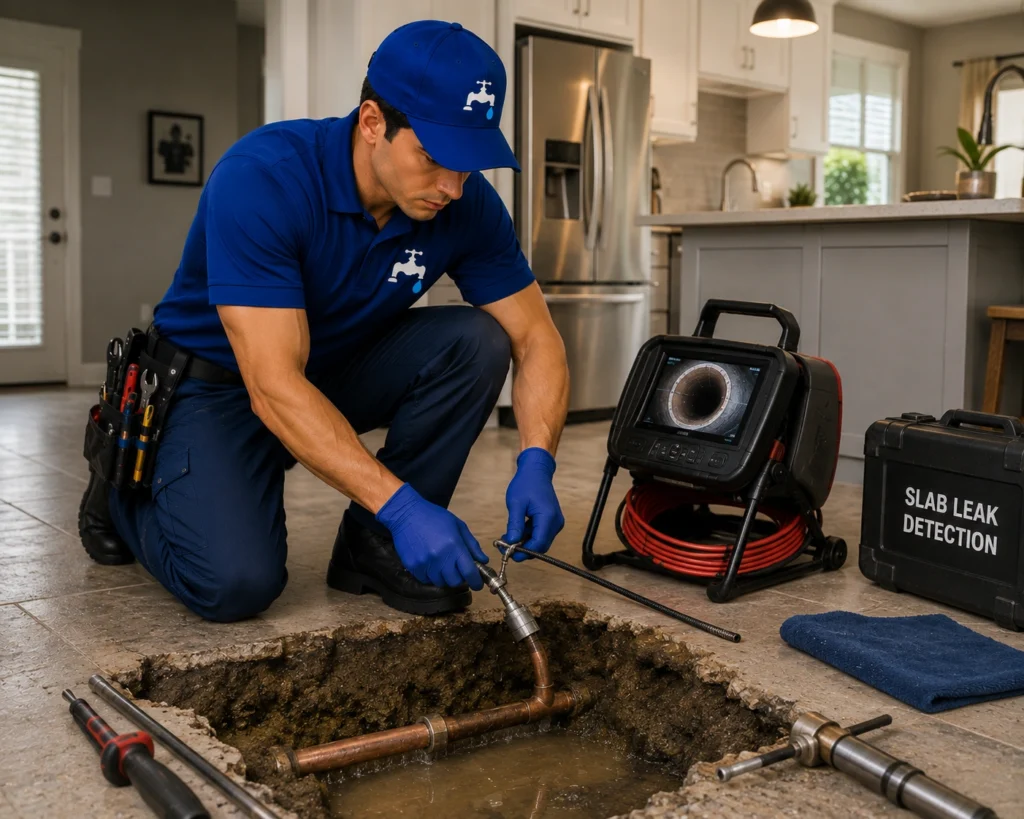
A slab leak is the one plumbing problem you can’t see, can’t reach, and can’t ignore. Somewhere under the concrete your house sits on, a water line has failed, and it’s been running quietly, maybe for weeks, showing itself only through side effects: a floor that’s warm for no reason, a bill that doubled, a damp patch of carpet in a room with no plumbing.
Slab leak repair in Florida is a routine job for us, because almost every home in this state is built directly on a concrete slab, with water lines running underneath or through it. When one fails, two things matter: finding the exact spot without guessing, and choosing the fix that solves it with the least disruption to your home. Both are covered below.
How to Tell If You Have a Slab Leak?
A warm spot on the floor. The most famous sign, and the most reliable. A leaking hot water line warms the concrete above it, and you feel it through tile or wood. If the dog has claimed one oddly specific spot on the floor, trust the dog.
A water bill that jumped with nothing to explain it. Slab leaks run around the clock. Even a small one adds up to thousands of gallons a month, and the bill is often the very first sign.
The sound of running water when every faucet is off. Stand somewhere quiet and listen. A faint, constant hiss or rush with everything closed means water is moving somewhere it shouldn’t.
The water meter spins with everything off. A two-minute check anyone can do: turn off every fixture and appliance that uses water, then watch the meter at the street. If it’s still moving, water is leaving the system.
Damp floors, lifting tile, or cupping wood in rooms with no plumbing. Water under the slab travels and comes up wherever it finds a path, often nowhere near the actual leak.
Mildew smell or unexplained mold at floor level. Moisture from below feeds it long before you ever see standing water.
One of these alone is worth a phone call. Two or more means stop wandering and get it located, because the leak is paying itself forward into your foundation, your flooring, and your bill every day it runs.
Found, Not Guessed: How We Pinpoint the Leak
The old horror story about slab leaks involves someone jackhammering trenches through a living room, hunting for a leak. That’s what happens when the repair starts before the location is certain, and it’s exactly what modern detection exists to prevent.
Listening equipment picks up the sound of water escaping under pressure, straight through the concrete. Heat-sensing tools spot the warm trail a hot water leak leaves in the slab. Together they narrow the leak down to a spot the size of a dinner plate, before anything gets opened. If you want the fuller picture of how hidden leaks get found, our [leak detection] page covers it. The short version for this page: the location comes first, is shown to you, and the repair is quoted for that exact spot.
Two Ways to Fix a Slab Leak, and How We Choose?
Spot repair: open the one spot, fix the pipe, close it up. When the leak is a single failure in an otherwise healthy line, we open the slab at the located point, repair the pipe, and restore the floor. One small opening, not a trench, because we already know exactly where to dig.
Reroute: leave the slab alone entirely. Often the better answer in Florida. Instead of going through the concrete, the failed line is abandoned in place and a new line is run overhead, through the attic and down the walls. No jackhammer, no floor opened at all, and your flooring stays exactly as it is. This is also the smarter choice when the leaking line is old enough that fixing one spot just moves the problem to the next weak spot down the same pipe.
Which one is right depends on three things we’ll walk you through honestly: the pipe’s age and condition, where the leak sits, and what your floors are worth protecting. A single failure in a young line usually earns a spot repair. A leak in an aging line, or under expensive flooring, usually earns the reroute. And if the line has failed more than once, that’s no longer a slab leak conversation, it’s a [repiping] conversation, and we’ll say so instead of selling you the same fix twice.
Slab Leak Repair Cost in Florida
Detection plus a spot repair typically lands in the $[500 to $2,500] range depending on depth, flooring, and access. Reroutes generally run more, commonly $[1,500 to $4,000+], but often win on total cost once flooring repairs are counted, because they don’t touch the floor at all. Whatever the situation, you get the location shown to you and a flat written price for the chosen fix before any concrete or drywall is touched. One more honest note: an undetected slab leak costs more than either option, every month it runs, in water alone.
Common Questions
Contact Us
Find the Spot. Fix the Spot. Keep Your Floors.
Pinpoint detection, an honest choice between repair and reroute, and a flat written price before anything is opened. Florida Plumbing Specialists, statewide.
Call Now, Answered 24/7